Have you ever looked at a menu in a foreign café or scrolled through a global e-commerce site and wondered exactly what those little stylized letters and symbols next to the numbers meant? You aren't alone. In a world that is more connected than ever, we are constantly interacting with the currency symbols of the world.
Whether you are planning a dream vacation to the Swiss Alps, managing a freelance business with clients in London, or simply curious about the history of the money in your pocket, understanding these symbols is your first step toward true financial literacy.
In this guide, we’ll dive deep into the fascinating evolution of money, explore the currencies of different countries with symbols, and show you how modern tools like the Jeton app are making the management of these global icons easier than ever before.
Managing a multi-currency account is no longer just for high-flying stock traders; it is a necessity for the modern traveler and the digital entrepreneur. Today, the United Nations recognizes 180 currencies used in 195 countries.
But before we look at how to send money with Jeton across these borders, we must understand where it all began. Understanding the different currency symbols and their origins helps us navigate the global market with confidence and security. Let’s start to explore!
What Is the Currency Symbol and Why Does it Matter?
A currency symbol is a graphical representation used as a shorthand for a currency's name, especially when referring to amounts of money. These symbols are often unique to a specific country or region, though some are shared across borders.
When you look at a currency symbols list, you see history and geography distilled into a single character. For example, the GBP currency uses the designation £ for the pound, derived from the Roman "Libra," while the US uses the $ symbol. Interestingly, many countries use the same symbol, which is why we have different currency symbols for the "Dollar"—such as $ (USD), Can$ (CAD), and AU$ (AUD).
If you are wondering how many symbols of currency in the world exist today, the number is close to the number of recognized currencies, though many smaller nations use three-letter ISO codes (like TRY for Turkey or PLN for Poland) instead of a unique graphic symbol.
Knowing these is vital because whether you are trying to figure out what currency does Turkey use or what currency is used in Spain, the symbol is the first thing you will see on a receipt.
What Was the First Currency in the World?
The first currency in the world was created by King Alyattes in Lydia, now part of Turkey, in 600BC and the first coin ever minted featured a roaring lion. The design was unmistakable, it represented the city: the foreparts of a lion and a bull facing each other.
Lydia’s new currency boosted the country’s trade economy making it one of the richest empires in Asia Minor. The wide use of the ‘Lydian Lion’ stamp showed these coins are the official tender of the king in his kingdom, something that has never been done before. Soon other kingdoms and empires followed and adopted their own seigniorage.
After a while, it became difficult to complete major transactions using large quantities of coins so in Ancient China they started using banknotes. The Chinese started trading with folding money during the Thang Dynasty and used it for more than 500 years before the practice began to catch on in Europe in the 17th century.
In Europe, the first issuer of paper money was Sweden, where in 1661 Johan Palmstruch’s Stockholm Banco introduced the first banknotes. Unfortunately, the bank subsequently overextended itself and had to call in government aid. Despite this example, other European countries soon followed the Swedish lead.
Major Currencies of the World and Their Symbols
In the global market, not all currencies are created equal. The major currencies of the world and their symbols dominate international trade. The "Big Three"—the U.S. Dollar ($), the Euro (€), and the Japanese Yen (¥)—are accepted for most international transactions.
- The U.S. Dollar ($): The world's primary reserve currency. Even if you are looking at what currency of Dubai is used in luxury hotels, you will often see prices quoted in USD alongside the local Dirham.
- The Euro (€): Used by the Eurozone. If you are asking what currency is Italy, what currency is Spain, or what currency for Portugal, the answer is the Euro. It was designed to represent the stability and unity of Europe.
- The British Pound (£): If you need to know what currency does London use, it is the Pound Sterling. Despite the UK's changing relationship with the continent, the Pound remains a pillar of global finance.
Even though it doesn’t hold an official title as a global currency, the International Monetary Fund states that the U.S. dollar is the most popular in the world. The value of the dollar is supported by the relative strength of the U.S. economy.
For those using Jeton finance, having a multi-currency account that supports these major players allows you to receive money with Jeton from almost anywhere without worrying about predatory conversion rates.
World Currencies Symbols and Signs
Most currencies nowadays have their own graphical representation for their names. The symbols are often unique to a specific county or region. The U.S. dollar and British pound sterling for example have become instantly recognisable globally by their currency symbol.
The GBP uses the designation £ for the pound, and the US uses the $ symbol to represent a dollar amount, although other countries also use $ to represent their currencies as well.
Some countries use the same currency symbol. The dollar symbol, $, is used by many countries. To avoid confusion, other letters may be included to help distinguish which country’s currency is being represented, such as Can$ for Canadian dollar. Knowing the currency symbols and signs is useful especially when traveling because you are likely to be using it while eating out or shopping.
Currencies of Different Countries with Symbols
When you travel, your digital wallet for international payments becomes your best friend. But you still need to know what to expect when you land. Let’s look at some specific regional questions:
European Destinations
- What currency does Portugal use? Portugal uses the Euro (€).
- What currency of Poland is used? Poland uses the Złoty (zł). If you are looking for what currency Poland uses specifically for digital trade, you will see the code PLN.
- What currency of Switzerland is official? Switzerland uses the Swiss Franc. If you see what currency is CHF in Switzerland, it stands for Confoederatio Helvetica Franc.
- What currency does Iceland use? Iceland uses the Króna (kr). You might also see this symbol if you ask what currency is KR in Sweden or Norway, though they are distinct currencies.
The Americas and Beyond
- What currency does Argentina use? Argentina uses the Argentine Peso ($).
- What currency does Colombia use? Colombia also uses the Peso ($).
- What currency is in Guatemala? Guatemala uses the Quetzal (Q), named after their national bird.
- What currency in Australia is used? Australia uses the Australian Dollar ($/AUD).
- What currency is MYR? This is the Malaysian Ringgit, symbolized as RM.
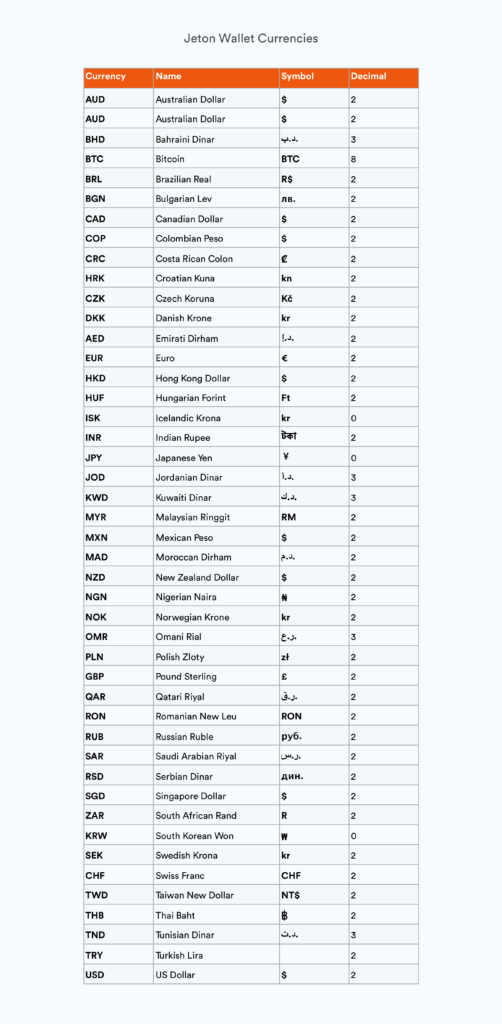
Here is also a list of currency symbols:
Whether you are checking which card is best for shopping or travelling, and more, your Jeton Card allows you to spend like a local.
The Rise of the Cryptocurrency
The rise of technology development has made it possible for new digital currencies to emerge, such as Bitcoin and Ripple, that are used as alternatives to traditional money. There are more than 4000 cryptocurrencies currently available in the market, with Bitcoin being the most popular and the most highly valued.
Cryptocurrencies are popular primarily because they protect the identity of the people using them. The good news is Jeton supports the cryptocurrency payment method. You can benefit from +50 payment methods across Europe with Jeton!
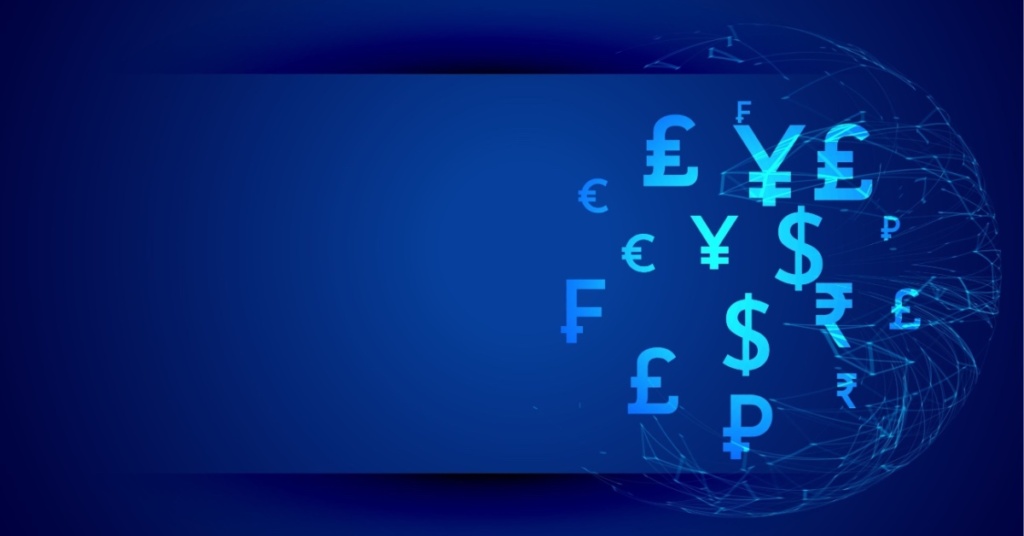
Manage Money in Multiple Currencies or Countries with Jeton
The rise of technology has made it possible for new digital currencies to emerge. We are no longer limited to the all country currency symbol list found in old textbooks. With over 4,000 cryptocurrencies available, the way we define "money" is expanding.
The good news is that Jeton payment systems support modern financial methods, including cryptocurrency. This means your online payment account is no longer just a place to store "old" money, but a gateway to the future. By using the Jeton app, you can bridge the gap between traditional countries and currency symbols and the borderless world of digital assets.
Managing money in multiple currencies used to be a headache involving "enormous fees" at traditional banks. However, a multi-currency wallet account with Jeton is simple and transparent. You can send money abroad instantly, bypassing the slow, archaic systems of the past.
Why Do You Need a Multi-Currency Account?
Managing multiple accounts can be complicated. And when you want to open a multi-currency account, banks can sometimes charge enormous fees. With Jeton, opening multi-currency accounts is simple and free. You can manage and send different currencies all from the same account and all around the globe.
When you understand what currency is GBP or why the UK uses a different symbol than the US, you can better monitor exchange rate fluctuations. Using a digital wallet for international payments like Jeton gives you an edge.
Instead of wondering what currency does the UK use and getting hit with a conversion fee at a London airport, you can hold GBP directly in your multi-currency wallet account.
-
Efficiency: Send money abroad instantly to friends or business partners.
-
Versatility: From what currency does London use to what currency is used in Spain, Jeton covers your needs.
-
Security: Your Jeton Card and payment wallet are protected by industry-leading encryption.
Wrapping Up
The journey from the "Lydian Lion" to the Jeton app represents thousands of years of human innovation. We have moved from heavy coins and confusing different currency symbols to a streamlined, digital experience.
Whether you are navigating the markets of Turkey, shopping in Spain, or sending funds to Argentina, the symbols of the world are no longer a barrier but are an invitation to explore.
Managing your global finances shouldn't be a struggle of paperwork and high fees. With Jeton Finance, you get a partner that understands the complexity of the all country currency symbol list and simplifies it into a single, user-friendly interface.
Are You Ready to Go Global?
Stop letting borders limit your financial freedom. Whether you need to receive money with Jeton from an international client or send money with Jeton to a loved one overseas, we provide the tools to make it happen effortlessly.
- Download the Jeton App via the App Store or Google Play today and experience the future of the multi-currency account.
- Open your online payment account for free and start managing the currency symbols of the world like a pro.
- Get your Jeton Card or Jeton Virtual Card. Enjoy the convenience of a digital wallet for international payments that travels with you or secure online shopping.
Sign up and join Jeton today for one app for all needs. Your passport to global finance is here!